
If you wish to export data in the form of an Excel document, eGRANT offers two options:
- Export of an overview table,
- Export based on a template.
1. Export of an overview table
In most lists in eGRANT (overview tables), you will find the Excel icon for a document.
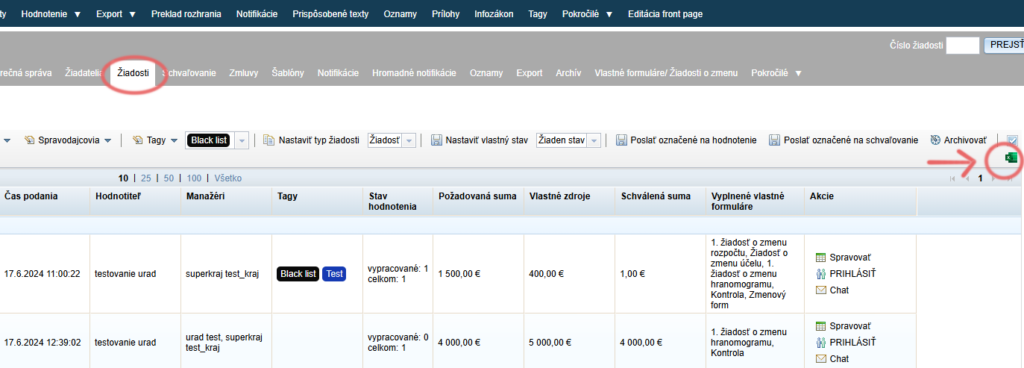
Clicking this icon downloads an Excel document containing the table data exactly as they are displayed (e.g. if you have a filter applied, the export will contain only the filtered list; if you have hidden some table columns, the export will not include the hidden columns, etc.).
2. Export based on a template
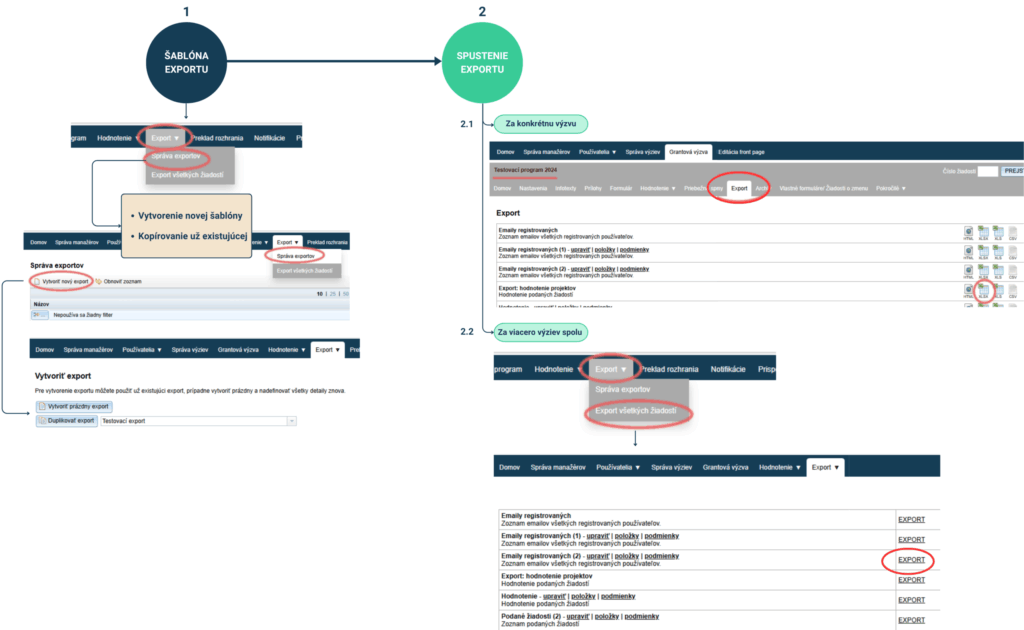
In this case, you must first create an export template in which you define which data will be displayed in which column of the Excel document. Only after creating such a template can you subsequently run the export, either for a specific call or for all calls.
You can export:
- all data contained in any form (application, final report, etc.) in the form of a simple field;
- for data contained in a form in the form of a table, you must take the format of the Excel document into account – the data of the entire table can be exported into a single cell or split into Excel columns;
- system data which are not contained in any form but are recorded by the system (e.g. application number, approved amount, etc.).
Consider exports as early as when creating forms
Consider which data you will later need to process for various internal purposes and make sure that the applicant either provides them in one of the forms, or that you can derive them in the Excel document from other available data, or that these data are recorded by the system in eGRANT.
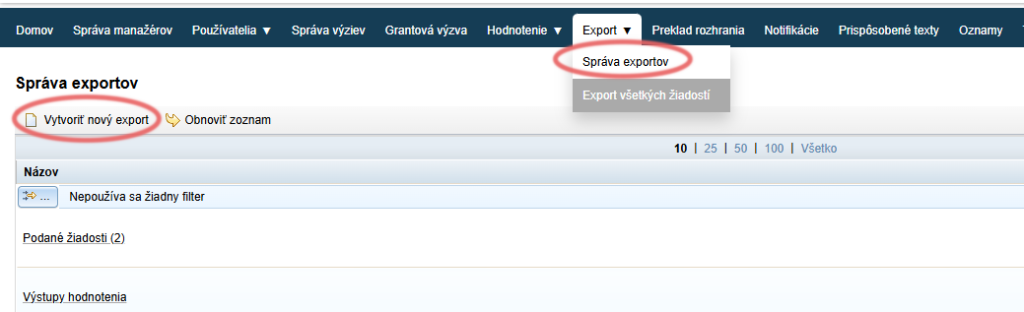
In the “Export” tab in the main menu, you can create export templates and also run an export for multiple calls.

You can run an export for a specific call in the “Export” tab in the call-level menu.

Export template
Data cannot be exported without an export template.
Principles for creating an export template:
Each form field has its own tag, and each system data item also has its own default tag.
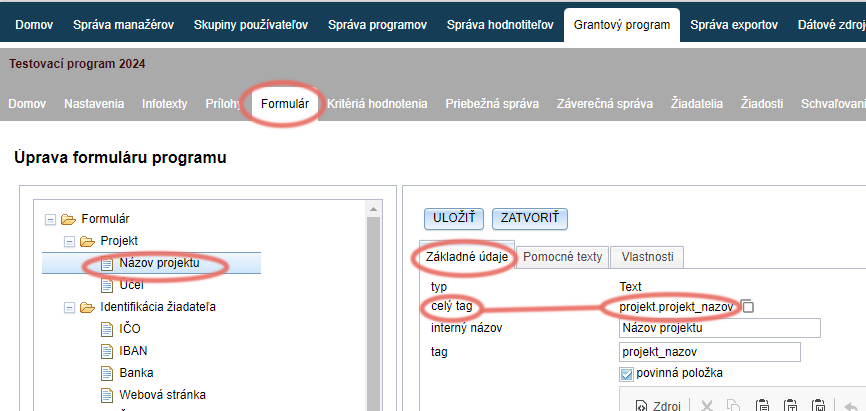
This means that you can subsequently use all these templates in any call.
This applies if the tags of the data you want to include in the export are identical across calls.
E.g.: You have two calls, “First Call” and “Second Call”. You want to create an export that will contain the applicant’s address and bank account. If the fields in which the applicant enters their address and bank account have the same tag in the form in the “First Call” and in the “Second Call”, it is sufficient to create a single export template. However, if, for example, the bank account field in the “Second Call” form has a different tag, you must create two templates (one template for the “First Call” and another template for the “Second Call”).
When you run an export, a complete list of all created templates opens, and a distinctive name/description will make it easier for you to navigate the list.
That is, which applications the export should cover (if you do not define any condition, the Excel document will contain data from all applications, including those still in progress).
E.g. if you want the export to contain data only from approved applications, or only from applications with a requested amount higher than €1,000, you can define this in the conditions of the export template.
Three export templates are already predefined in the system:
- Registered users’ emails – a list of the email addresses of all registered users
- Export: project evaluation – the export contains: application number, submitter name, application title, requested amount, own resources, application status, the final score (either the sum or the average, depending on the evaluation settings), the score for individual evaluation criteria for each evaluator and the proposed amount for each evaluator (if it is part of the evaluation criteria).
- Register verification results (available if you use the register verification service) – the export contains: application number, submitter, project title, check status, date of the check, overall check result (OK = all registers OK, NOK = a problem was found in one of the registers) and the check result for individual registers (1 = OK, 0 = problem).
These templates cannot be edited, but you can duplicate them into new export templates.
For participation managers
In addition to those mentioned above, a predefined template is available for participatory budget managers:
Vote export – contains data from the voting form (depending on the form type): name, phone number, city, street, postcode, email, age category, source, date and time, and the project(s) the voter voted for.
Running an export
Once you have created an export template, you can export data based on it.
After selecting the call, in the “Export” tab in the call-level menu, by clicking the “XLSX” icon.
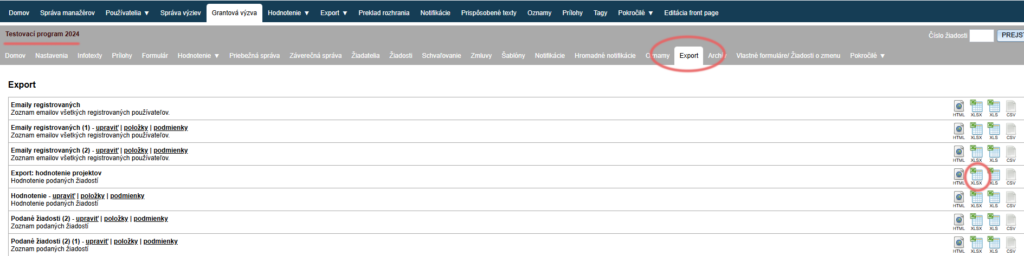
In the “Export: Export všetkých žiadostí” tab in the main menu, by clicking the “EXPORT” link.

To be able to export data for multiple calls, the tags of these data must match across calls.
System data have the advantage of fixed, default tags (e.g. application number – “application_number”).
For form data, however, you enter the tag manually when creating the form item, so there is a higher probability that the tags will not match.